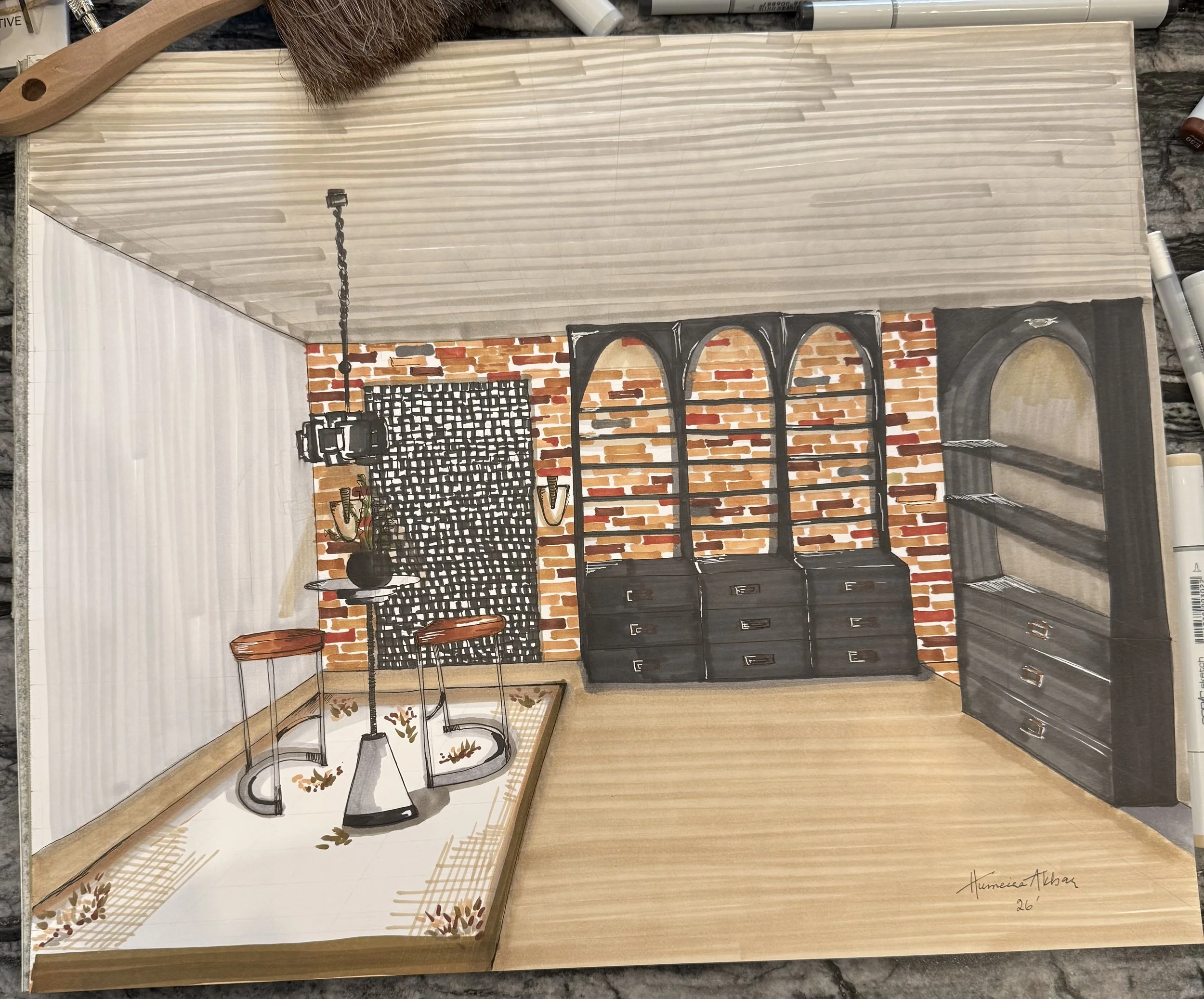
Why Every H&S Interiors Design Starts With a Pencil, Not a Screen
The Pencil Is Still My Favorite Tool
Before founding H&S Interiors and Organization, I trained as an artist — mixed media, watercolor, oil painting, drawing. So it's no surprise that the same principles I learned in a painting studio show up in every room I design: balance, scale, color theory, symmetry.
What might surprise you is that every H&S Interiors design still starts with a pencil, not a screen.
Why hand-drawn, in a digital world
Technology has changed this industry quickly. Today, you can describe a room to an AI tool and have a rendering back within seconds. We use plenty of digital tools ourselves — 3D software is essential to the detailed, technical phase of any project. But that comes later. In the earliest phase, when an idea is first taking shape, we still reach for a pencil before anything else.
That choice isn't sentimental. It's about accuracy.
A sketch that's actually a plan
When a client receives a hand-drawn rendering from H&S, it's never just a pretty picture — it's a scaled, accurate representation of their actual space. That countertop is drawn at 36 inches off the finished floor. That marble you've been dreaming about is sized to your real kitchen, not a generic stand-in. The pendant lighting above the island, the cabinet hardware, the floor plan if we're reconfiguring the layout — all of it is already considered and represented, because every design decision is being made in real time as the drawing takes shape.
The moment clients remember
The reaction is almost always the same the first time a client sees their hand-drawn rendering: "Wait — you drew this?"
That moment matters to us. It's proof that a space can be imagined with precision and with heart, by a trained eye and a steady hand, before it's ever translated into software. It's one of the most personal parts of our process, and one of our favorite ways to show a client their future home before a single wall comes down.