
The Design Secret Behind Every Cohesive Space
Almost 80% of the consult calls we take come down to one request: "help us get a cohesive design."
It's the number one place homeowners get stuck — and honestly, it's often the first thing we notice walking into a space. Multiple styles competing for attention. A piece of art hung a size too small for the wall it's on. A color palette that never quite committed to itself.
What Does "Cohesive Design" Actually Mean?
Cohesive design is what makes a home flow from the front door to the back — no jarring transitions, no rooms that feel disconnected from each other. It's easier to feel than to explain. You know the moment it's missing, even if you can't quite name why.
As designers, we lean on a handful of core principles to create that flow: rhythm, balance, proportion, color theory. All of them matter. But there's one we come back to more than any other.
The Principle We Use Most: Repetition
Repetition is the simplest, most reliable way to make a space feel intentional. We repeat color. We repeat style. We repeat shape — on purpose, and more than once.
If there's an arch over a doorway, you'll likely see that same curve echoed again in the cabinetry. If we choose a color for a space, we're bringing it back at least two more times before we call the room finished.
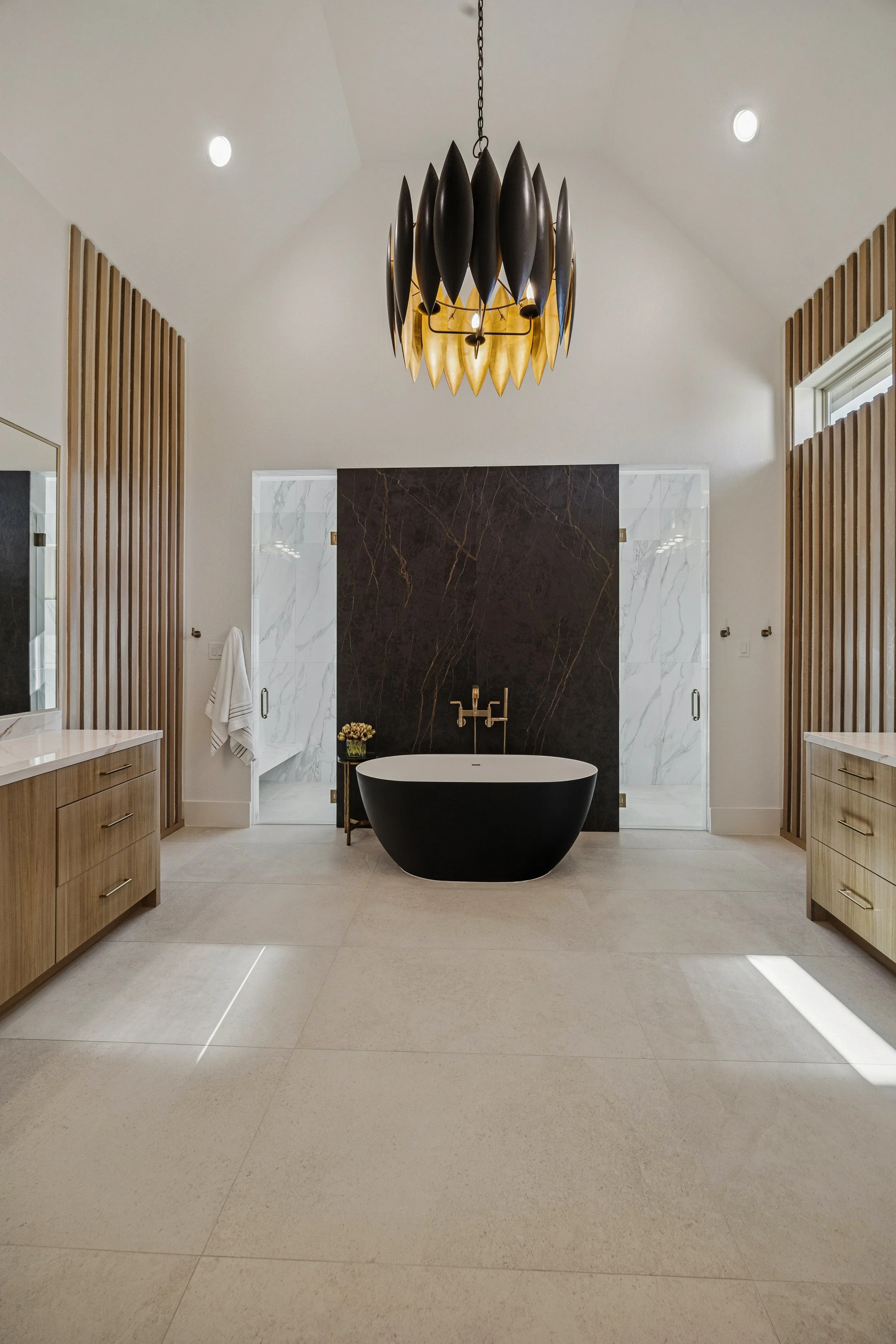
Let's use this bathroom as a case study. Where do I want your attention to go in this space? That tub wall! So I am using a very dark contracting black color. But see how I am pulling that black in two more times? There's warmth in the space with the wood tones, that's repeated in the floor tile and again in the cabinetry. Vein patterns? In the shower and the tub wall. Repetition is a subtle design flex-- but it's major when it comes together.
Where Style Gets Complicated
Style matters just as much here — and this is often where conflict shows up. Maybe you and your spouse don't agree on the direction for the house. Maybe there's a piece of artwork that's been handed down for generations. Or maybe it's a travel find you can't quite part with.
Wherever it comes from, sometimes the better move is to let go of the piece that's causing the conflict, rather than force it into a space where it just won't work.
A Simple Test for Any Room That Feels "Off"
Next time something in your space feels not-quite-right, ask yourself: can repetition fix this? Is that color repeated at least three times? That's how we achieve unity — another design principle that ties everything together, and one of the fastest ways to diagnose what's missing in a room.
If you're stuck on where to start, that's exactly what we're here for.